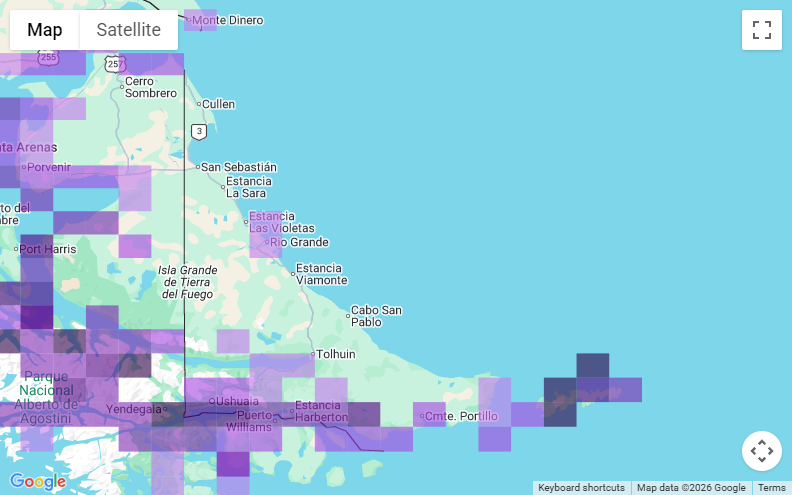
The Flightless Steamer-Duck is a massive, heavy-bodied duck of southern South America, restricted to marine environments along exposed and sheltered coasts. Its extremely short wings leave much of the rear flank visible and render the species essentially flightless. When alarmed, it propels itself across the water by beating its wings while running along the surface — a behavior that gives steamer-ducks their name.
It is the largest member of the genus within its range and shows only limited sexual dimorphism compared to other Tachyeres. Both sexes display a grey body, pale grey head, bright orange bill, and white wing patches. Usually encountered in pairs or small family groups, it is a dominant presence along rocky Patagonian shores.
Conservation note
The Flightless Steamer-Duck is globally listed as Least Concern and remains common within its restricted coastal range, with an estimated population between 25,000 and 100,000 individuals. However, its complete reliance on marine shoreline habitats and its inability to fly make it inherently vulnerable to localized threats. Potential risks include oil pollution, coastal habitat degradation, and large-scale environmental disturbances such as extreme tidal events. In parts of Chile, it is considered Near Threatened at the national level due to reported regional declines. Continued protection of intact coastal ecosystems is essential for the long-term stability of the species.