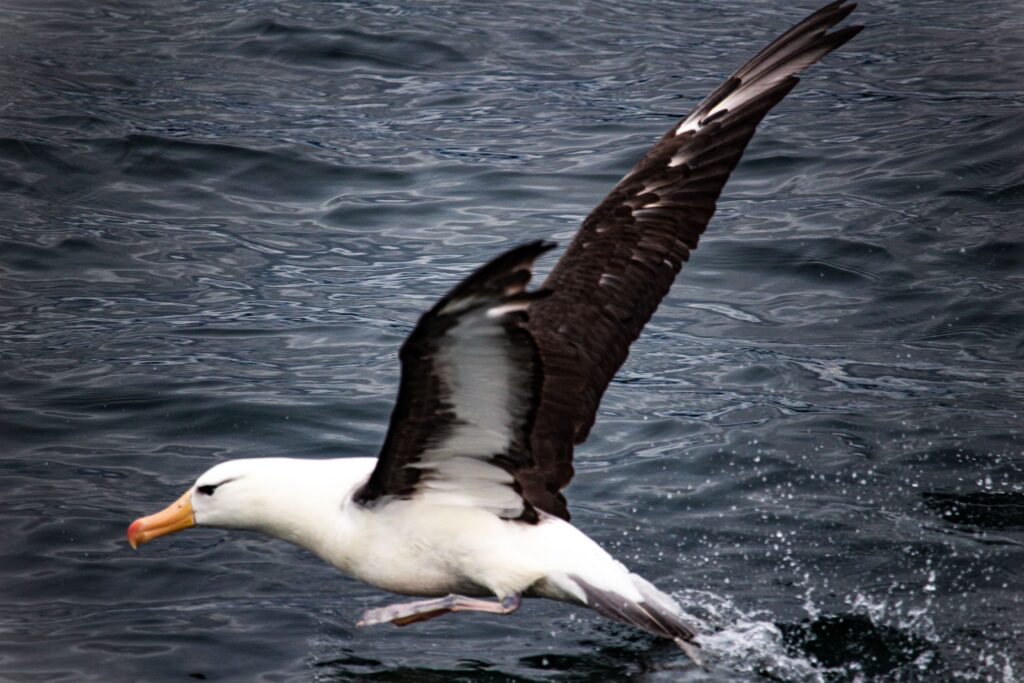
A robust Southern Ocean “medium-sized albatross” the Black-browed Albatross is one of the most familiar albatrosses thanks to its huge at-sea range, relative abundance, and its tendency to use inshore waters more than many other albatrosses. Adults are striking: a white head, dark back, and a yellow bill with an orange tip, plus the namesake black “brow” around the eye. At sea it often feeds alongside other seabirds, sometimes following boats or cetaceans, and it is famous for far-flung vagrancy, with repeated records in the North Atlantic and Europe.
Conservation note
Globally listed as Least Concern, but that does not mean risk-free. Historically and regionally, major pressures include fishery bycatch (especially longlines) and shifting prey availability; reliance on fishery discards varies among colonies and years. Where best-practice mitigation is applied (bird-scaring lines, line-weighting, night setting, offal management), seabird bycatch has been dramatically reduced in some managed regions—yet trends can still differ by colony/subpopulation, and the Campbell subspecies (impavida) remains of higher conservation concern.