TIERRA DEL FUEGO BIRDING TOURS

Ochre-naped Ground-Tyrant

Passeriformes > Tyrannidae
Muscisaxicola flavinucha

IUCN Red List category

Least Concern

Good birding season

Spring & Summer

Best time to visit

October to March

Records in Tierra del Fuego

529 observations

143 photos

1 audios

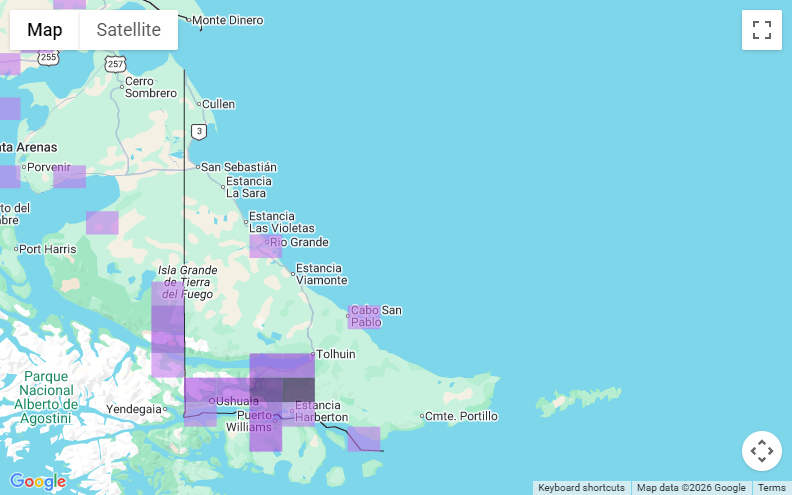
RANGE MAP BY EBIRD

OVERVIEW

About Ochre-naped Ground-Tyrant

A large and long-winged ground-tyrant of the Andes and southern Patagonia, the Ochre-naped Ground-Tyrant is distinguished by its pale brownish-gray plumage and distinctive pale ochre patch on the rear crown and upper nape. The white forehead and supercilium contrast with darker wings and a mostly black tail edged white.

Strongly terrestrial, it often stands upright while foraging and frequently performs a characteristic tail-scissoring motion, rapidly opening and closing its tail. Its flight is typically fast, low, and swooping over open terrain.

Two subspecies are recognized: the more northern flavinucha and the southern brevirostris, though the limits of their breeding and nonbreeding ranges remain imperfectly understood.

Conservation note

Listed as Least Concern, with a broad distribution estimated at over one million square kilometers and a generally stable population trend. It occurs in numerous protected areas across Peru, Bolivia, Chile, and Argentina.

Localized habitat degradation from overgrazing may affect some breeding sites, and future impacts of climate change on high-elevation habitats remain uncertain. Overall, the species remains fairly common within suitable environments across its extensive range.

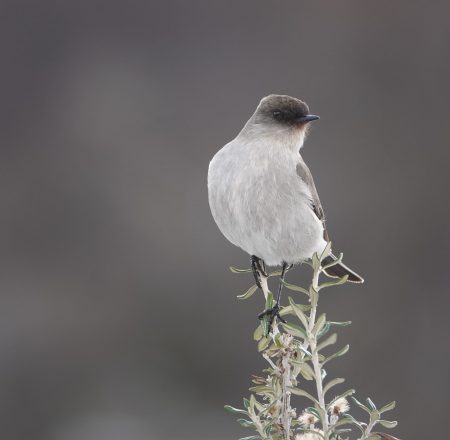
BIRDS IMAGE GALLERY

Ochre-naped Ground-Tyrant

Habitat and distribution

Breeds in the Andes of Chile and western Argentina, from northern Chile south through Patagonia to Tierra del Fuego, generally between 2,000–4,800 m in the north, but at lower elevations in southern Patagonia. Breeding habitat includes rocky slopes, sparse grasslands, alpine steppe, high-altitude lagoons, and barren mountain terrain. In the far south, it also occupies Patagonian steppe and open uplands. During the nonbreeding season, migrates north along the Andes to western Bolivia and southern–central Peru, typically between 3,500–4,900 m.

Observation tips

  • Look for it in open highland habitats, especially rocky slopes and short alpine grasslands.
  • Often seen standing upright on rocks or low ridges before making short ground runs or low flights.
  • Note the pale ochre crown patch, visible even at moderate distance.
  • Tail-scissoring behavior is a useful field clue when the bird is perched or walking.
  • In winter, scan high Andean puna landscapes and lakeshores for solitary birds or loose groups.

Ochre-naped Ground-Tyrant

Top birding tours

BOOK YOUR TOUR

Ready to explore Tierra del Fuego with us?

Get in touch to check availability, customize your experience, or ask any questions before booking.