TIERRA DEL FUEGO BIRDING TOURS

Thorn-tailed Rayadito

Passeriformes > Passeriformes incertae sedis
Aphrastura spinicauda

IUCN Red List category

Least Concern

Good birding season

Year-round (best in Spring)

Best time to visit

October to January

Records in Tierra del Fuego

5639 observations

582 photos

42 audios

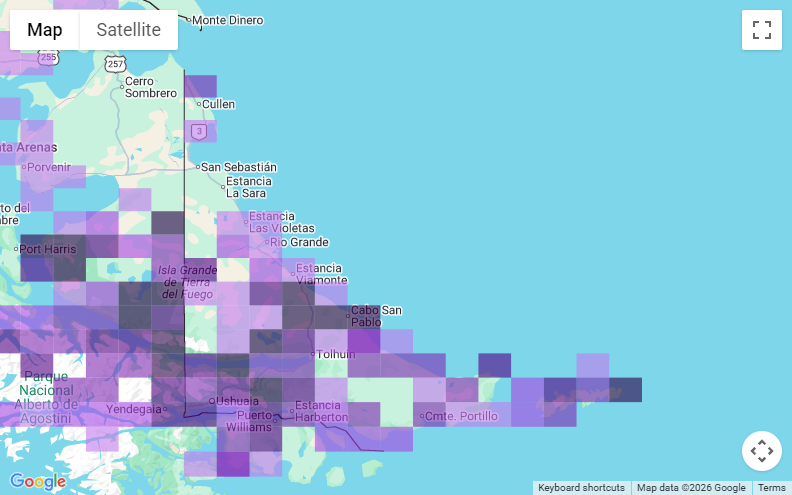
RANGE MAP BY EBIRD

OVERVIEW

About Thorn-tailed Rayadito

A small, active furnariid of southern South America, the Thorn-tailed Rayadito is one of the most characteristic forest birds of Chile and Argentina. It is easily recognized by its bold buff-and-black head stripes, contrasting wing pattern, and distinctive spiny tail projections formed by stiffened shafts on the central feathers.

Highly vocal and energetic, it moves acrobatically through foliage in noisy groups and is often the nuclear species in mixed-species flocks. It is closely related to the allopatric Masafuera Rayadito of Alejandro Selkirk Island.

Conservation note

Listed as Least Concern and common to locally abundant across most of its range. It occurs in several protected areas, including Vicente Pérez Rosales, Nahuelbuta, Cerro La Campana, and Tierra del Fuego National Park.

Although parts of its range have experienced forest modification, the species shows adaptability to secondary habitats and plantations. Continued preservation of temperate southern forests remains important for maintaining stable populations.

BIRDS IMAGE GALLERY

Thorn-tailed Rayadito

Habitat and distribution

Occurs in central and southern Chile (south from southern Coquimbo) and extreme western Argentina (south from Neuquén) to Tierra del Fuego and Staten Island, with additional island populations on Chiloé, Mocha Island, and the Diego Ramírez archipelago. Accidental in the Malvinas Islands. Inhabits temperate Nothofagus forests, humid mixed woodlands, forest edges, and second growth. On treeless islands it may use tussock grass or shrub habitats. Primarily from sea level to 1,200 m, locally up to 2,000 m. Resident throughout its range.

Observation tips

  • Most easily detected by its thin, dry trill and sharp metallic calls (“zee-zee,” “tic”).
  • Frequently encountered in small flocks of 4–7 birds, often within mixed-species flocks where it acts as a focal species.
  • Forages actively from understory to canopy, gleaning insects from foliage, moss, lichens, and bark.
  • The graduated, spiny tail is often visible when perched upright on trunks or branches.
  • Particularly common in mature Nothofagus forest but also adapts to second growth and even pine plantations.

Thorn-tailed Rayadito

Top birding tours

BOOK YOUR TOUR

Ready to explore Tierra del Fuego with us?

Get in touch to check availability, customize your experience, or ask any questions before booking.