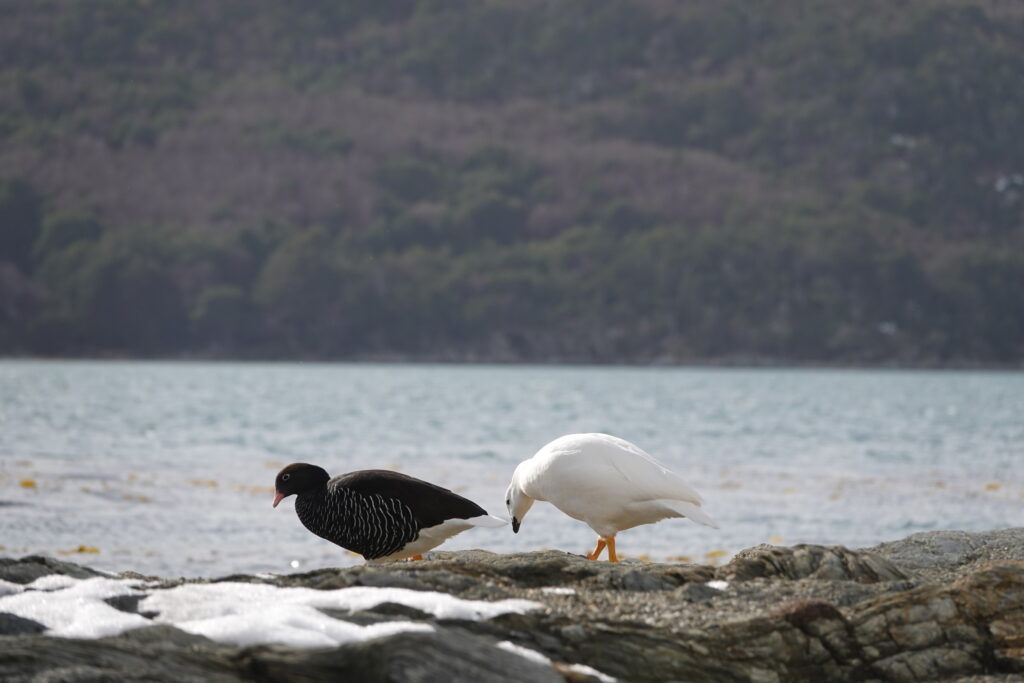
The Kelp Goose is one of the most distinctive coastal birds of southern Chile and Argentina, immediately recognizable for its extreme sexual dimorphism. Adult males are entirely white, while females are darker and intricately patterned, with white barring on black underparts and a subtle iridescent green wing bar. Both sexes show bright yellow legs, a feature that stands out against the dark tones of rocky shorelines.
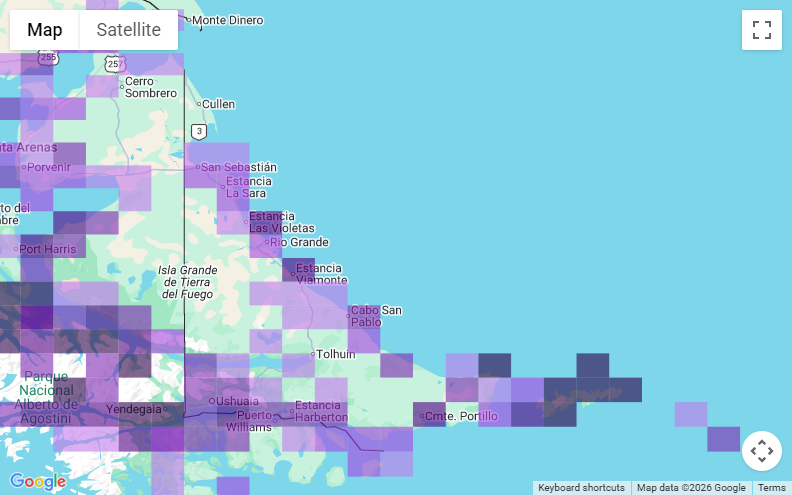
Unlike other South American sheldgeese that dominate inland grasslands and wetlands, this species is strongly tied to the marine edge. In Tierra del Fuego and the Beagle Channel region, it is a characteristic presence along exposed coasts, usually encountered in pairs or small family groups rather than large flocks. Its calm, territorial behavior and close association with kelp beds make it a predictable inhabitant of suitable shoreline habitats.
Conservation note
The Kelp Goose is currently listed as Least Concern, with populations considered stable across much of its range. It remains widespread in both continental southern South America and the Malvinas. Because it inhabits remote and rocky coastal environments, it faces fewer direct pressures than inland grazing geese. However, localized risks include oil spills and coastal pollution, which could affect shoreline feeding habitats.