
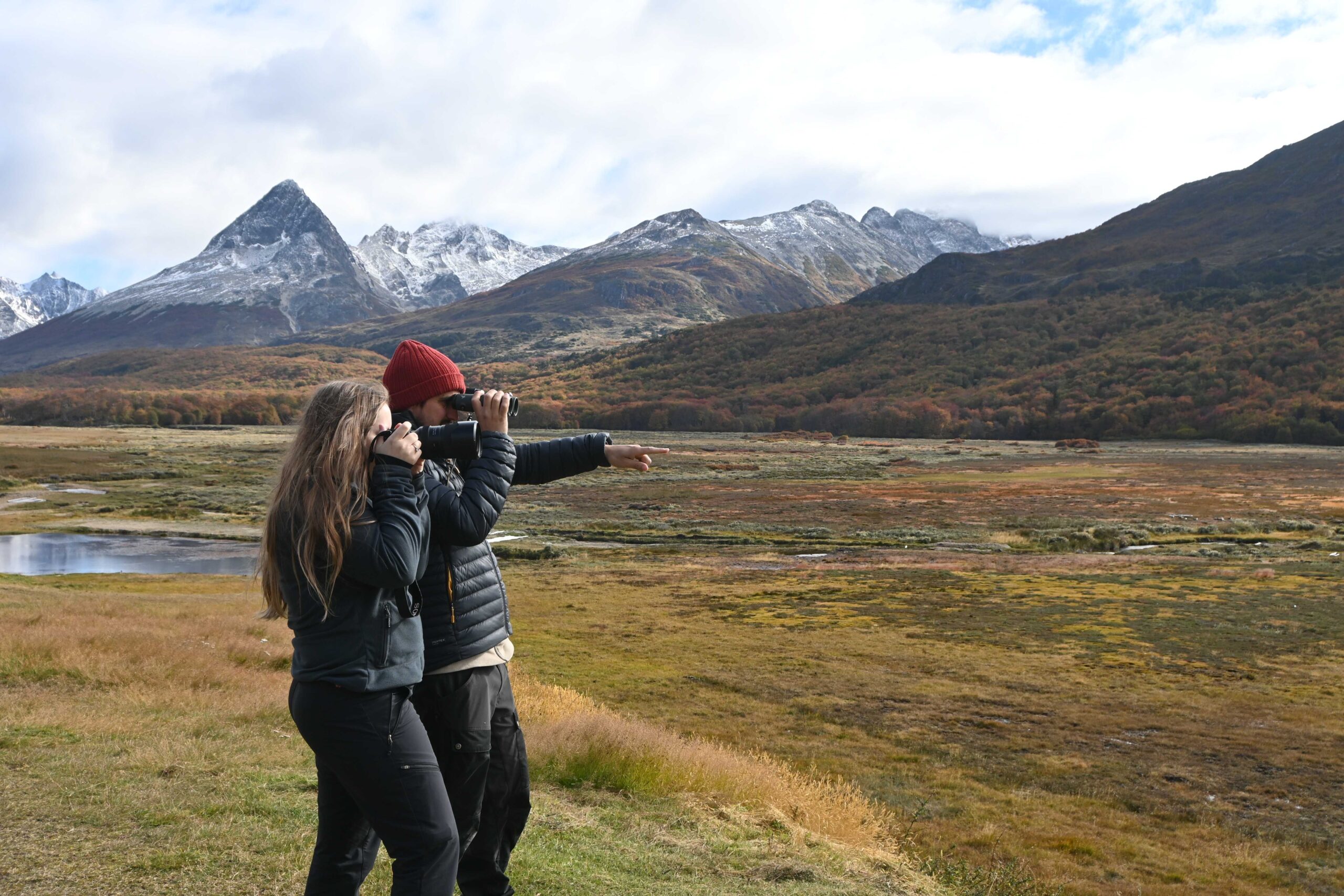
There are places where watching birds changes the way you see everything else. Tierra del Fuego is one of them.
This place does not give itself away easily. The wind arrives without warning — and strong. The sky shifts in minutes. The landscape — forest, steppe, channel, high mountain — carries a density that takes time to absorb. It is not hostility in any human sense. It is indifference. The territory existed long before any observer arrived with binoculars, and it will continue long after. That, paradoxically, is part of what makes being here matter.
What works against you is what keeps everything in place
The cold, the distance, the difficulty of access — everything a conventional traveler might consider an inconvenience — is precisely what preserves this place. And for the species that inhabit it, those conditions are not obstacles. They are home.
The Magellanic Woodpecker did not reach the Nothofagus forest despite the isolation. It reached it because of the isolation. The White-bellied Seedsnipe does not tolerate the wind-exposed rock of the high mountain — it requires it. The seedsnipes and dotterels of the open steppe did not develop their cryptic plumage despite the exposure — they developed it in order to exist within it. The seabirds that appear over the grey water of the Beagle Channel spend months at sea in the Southern Ocean without touching land, in conditions no other environment on the planet replicates. When one of them crosses the channel at close range, it is not an accident. It is the result of millions of years of adjustment between an organism and a specific place.
What feels hostile to us is, for them, precisely their niche.
Not quantity — depth
Tierra del Fuego is not a destination of abundance in the tropical sense. It does not offer hundreds of species in a single day, or forests dense with color and sound at every turn. That is a different kind of birding, and a valid one. What this place offers is something else: a smaller number of species, each one shaped by conditions so specific that seeing them here — in this light, in this wind, in this landscape — is a different kind of encounter. Some of these species are not simply adapted to these conditions. They originated within them, and exist nowhere else on earth. The Magellanic Plover, found only in the southernmost reaches of Patagonia and Tierra del Fuego, is not a visitor to this landscape. It is a product of it — as endemic to this corner of the planet as the wind that shapes it.
And then there are the visitors. Shorebirds and seabirds that cross the entire planet to feed in these waters and along these coasts — species that breed in the Arctic and arrive here following routes that span hemispheres. Their presence in Tierra del Fuego is not incidental. This place is a destination for them too.
Watching birds here means reading the whole territory. Each species is a clue about how the ecosystem that sustains it works. The subantarctic forest, the Patagonian steppe, the high mountain, the channel, the open ocean — each habitat has its own logic, its own community, its own silence. Understanding a bird means understanding the place where it lives. And understanding the place changes the way you see the bird.
The discovery that does not end
There is something the far south offers that no established destination can replicate: the genuine sense that not everything has been written yet. The ornithology of this region still has real margins. A documented observation here can add something that was missing. A recorded behavior can complete a gap in what is known.
The birder who comes to Tierra del Fuego does not arrive to consume packaged nature. They arrive to witness something the territory holds with a certain reserve — and releases, when it does, in a way that is not easily forgotten.
That is why people come back.
